

Project Description

Circular Critical Raw Material Strategies for PEM Water Electrolysis
Multi-gigawatt deployment of proton exchange membrane water electrolysis (PEMWE) is central to European hydrogen strategy, yet remains fundamentally constrained by its reliance on scarce and critical raw materials (CRM). Iridium, indispensable as the oxygen evolution reaction (OER) electrocatalyst under the acidic, oxidative conditions of the PEMWE anode, presents a particularly acute bottleneck: annual primary production of ~7–9 tonnes is incommensurate with projected electrolyser manufacturing capacity. Likewise, the use of Fluorine (another CRM) rich ion exchange ionomers, represents a challenge in terms of End-of-Life (EoL) considerations.
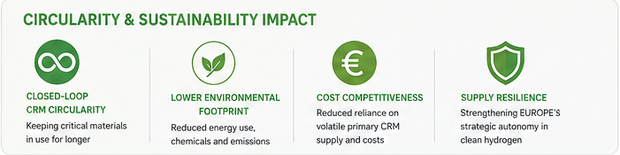
Use of both materials represents supply chains risk/resilience and lifecycle burden (anticipating future large scale technology deployment). Conventional (e.g. pyro- and hydrometallurgical) recovery routes are energy- and reagent-intensive, poorly adapted to the low metal inventories and complex architectures of catalyst-coated membranes, and largely unvalidated for EoL electrolyser stacks.
Approach
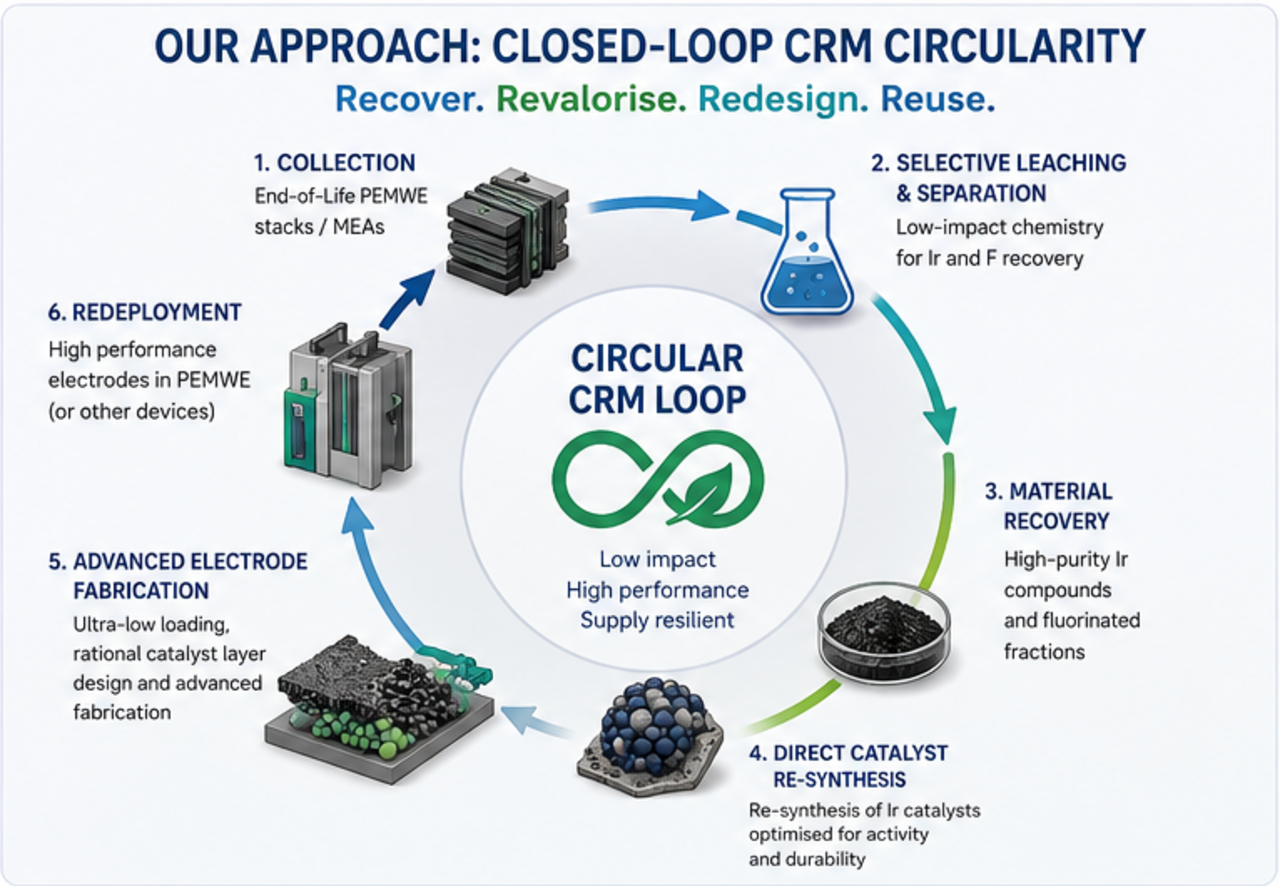
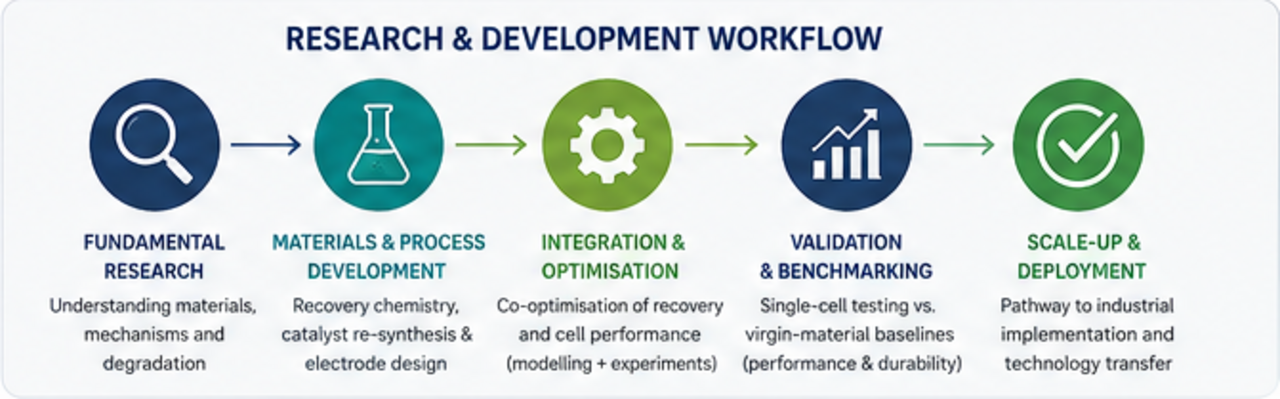
The project develops a low-impact recovery and revalorisation route for CRMs from PEMWE membrane electrode assemblies, coupling selective leaching and separation chemistry with direct catalyst re-synthesis to for example minimise process energy, reagent consumption, and material losses across the recovery chain. Computational modelling is integrated with materials chemistry and electrochemical engineering to co-optimise: recovery yield and selectivity and cell-level performance of novel electrodes (based on recycled components) under industrially relevant operating conditions. Recovered materials are redeployed in ultra-low-loading electrode architectures, exploiting advanced fabrication and rational catalyst layer design to maximise Ir-specific activity and utilisation while maintaining durability targets consistent with industrially demanded stack lifetimes. Benchmarking against virgin-material baselines is performed at single-cell level with standardised protocols, providing quantitative evidence that recycled-CRM electrodes can meet or exceed state-of-the-art performance and degradation metrics.
Project Objectives
Develop a novel, low-impact approach to CRM recycling from PEMWE
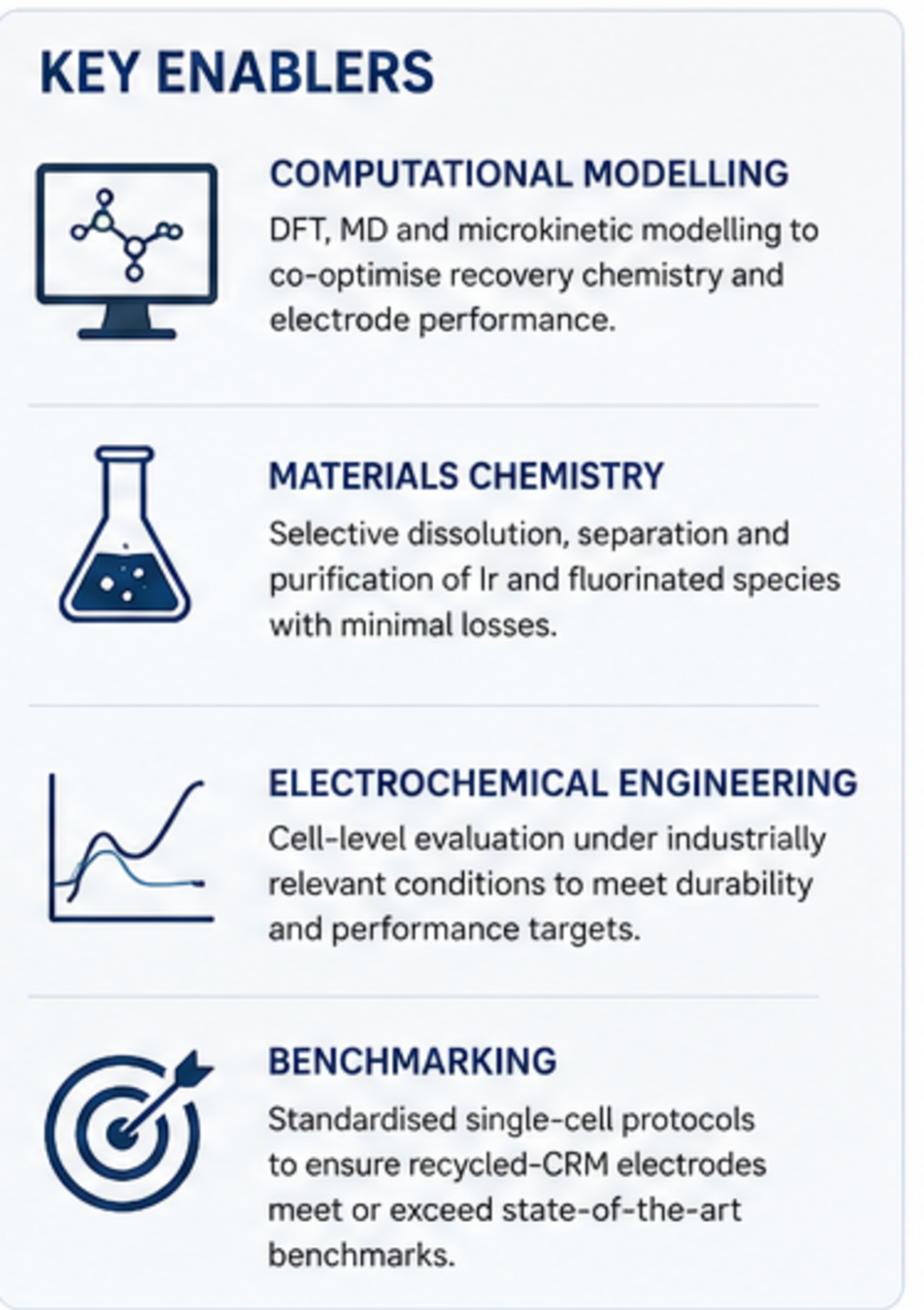
Combine computational modelling, materials chemistry, and electrochemical engineering to optimise recovery, reuse and performance
Demonstrate low CRM, high-performance electrodes through innovative design and fabrication